The lagoon is part of Venice, and each of its islands is a world of its own: glass on Murano, colour on Burano, silence on Torcello, Palladio across the water, beaches and bike rides on the Lido. How to get there from Fraivolti, what to see and how to plan the day.
At a glance
- Murano for glass, Burano for colour and lace, Torcello for history and silence: you can see all three in a day, if you start early.
- The quickest way to Murano is line 3, from Piazzale Roma, 10 minutes on foot from Fraivolti; from Murano, line 12 continues to Burano, and the little line 9 to Torcello.
- San Giorgio Maggiore and the Giudecca are just across the water from St Mark’s; the Lido and Pellestrina are for the beach and a bike ride.
- In high season the boat back from Burano can have a queue: leave a little earlier or later than everyone else.
- Tickets and passes are explained in Getting around Venice.
Murano, Burano and Torcello in a day
The classic day in the northern lagoon. Start with Murano: the quickest way there from Fraivolti is line 3, which goes straight to the island in about 20 minutes. Board it at Piazzale Roma, about 10 minutes on foot from Fraivolti, where the line starts and the boat is still empty, or at the station (Ferrovia). From Murano (Faro), line 12 continues to Mazzorbo and Burano, and from Burano the little line 9 crosses to Torcello in five minutes. At the end of the day, line 12 brings you back to Fondamente Nove: from there, after a short walk, line 1 from the Ca’ d’Oro stop takes you down the Grand Canal to San Tomà, or you can walk back to Fraivolti in about 25 minutes.
Go to Murano in the morning, when the glassmakers are at work, have lunch on Burano, and spend the afternoon on Torcello. Then come back at sunset, across the northern lagoon, with the bell towers of Venice ahead of you: one of the loveliest boat rides there is.
Good to know: in high season the boat back from Burano can have a long queue, especially in the late afternoon. Leave a little earlier or later than everyone else, and check the timetables in the CheBateo? app or on the ACTV website.
Murano
In 1291 the Republic moved its glass furnaces to Murano, to keep the risk of fire away from the city, and the island has been working glass ever since. Several furnaces open their doors for a glassblowing demonstration, but which ones changes over time: look out for the signs along the fondamente.
- The Glass Museum. In Palazzo Giustinian, the story of Murano glass from Roman times to the present day: the best place to understand what you will see in the shop windows. Open every day.
- Santi Maria e Donato. One of the oldest churches in the lagoon, with a 12th-century mosaic floor of marble and glass, peacocks and griffins included, and a golden Virgin in the apse. Behind the altar hang some large bones which, legend has it, belonged to a dragon slain by St Donatus.
- Trattoria Busa alla Torre. In Campo Santo Stefano, at the foot of the clock tower, with tables out in the campo: fish and Venetian dishes, for lunch only.
Good to know: genuine Murano glass carries the Vetro Artistico Murano trademark, on a label on each piece and on a sticker in the shop window. And avoid the “free” boat trips to a glass factory offered around St Mark’s: they usually end in a showroom with a sales pitch.
Burano and Mazzorbo
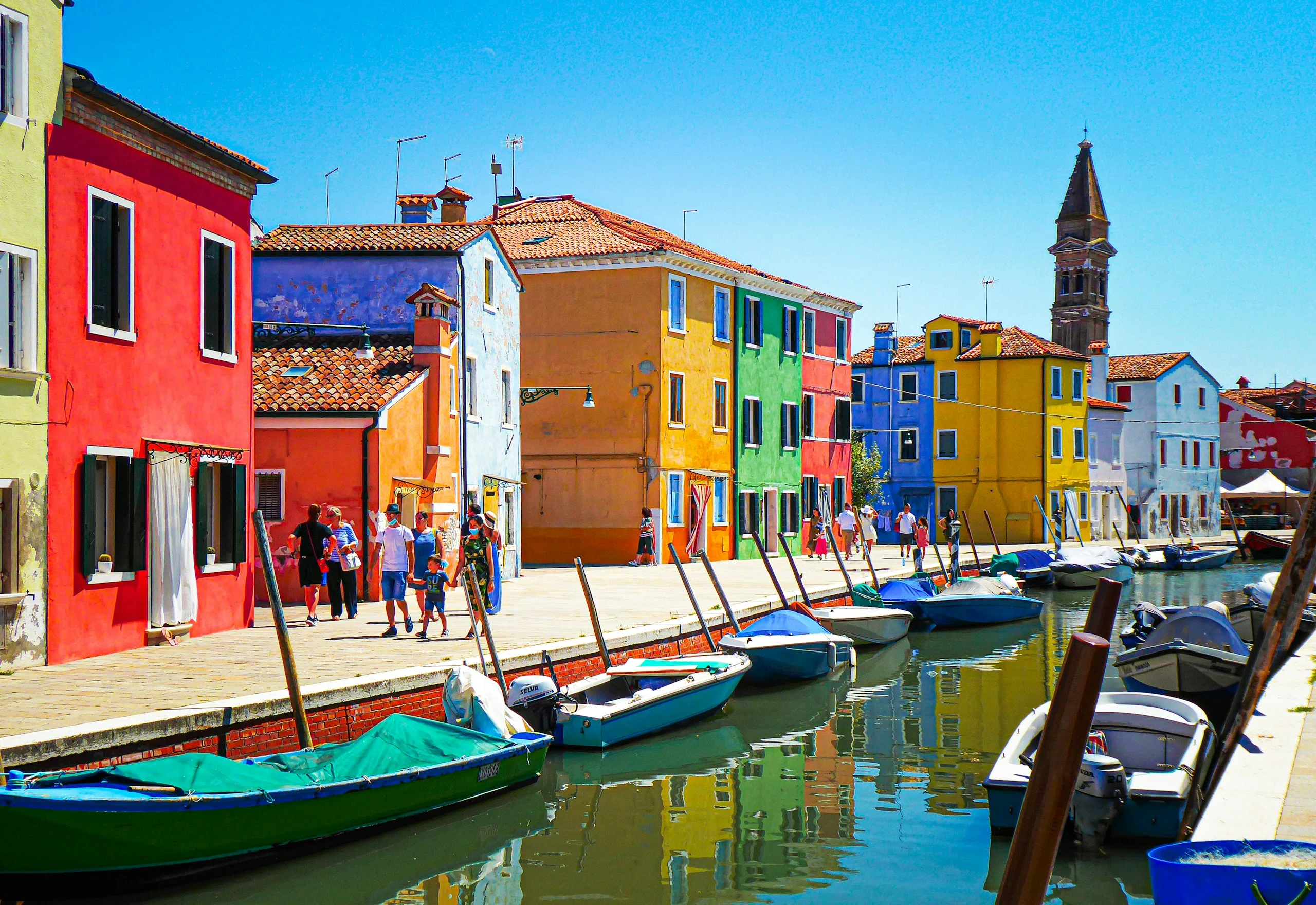
Burano is still a real village, where everyone knows everyone, washing hangs between the houses and boats are moored by the front door; and in the late afternoon, when the day-trippers head back, its colours glow in the low light of the lagoon.
- The colours. Tradition has it that the fishermen painted their houses in bright colours to recognise them from the lagoon in the fog. Walk away from the main street: the quietest calli are the most beautiful.
- San Martino. The church on the main square, with a bell tower that leans visibly, as the ground beneath it has slowly sunk.
- The Lace Museum. In the old lace school on the main square, the story of Burano needle lace, once worn in the courts of Europe. Closed on Mondays.
- Trattoria Al Gatto Nero. A family restaurant since 1965, on a canal a few minutes from the vaporetto: fish from the lagoon and the classic risotto de gò, made with goby, the dish of Burano. Book ahead.
- Mazzorbo. A long wooden bridge leads to Mazzorbo, quieter and green, with the vineyard of Venissa, where the Dorona, the golden grape of the lagoon, has been replanted. Its restaurant has a Michelin star: see Eat and drink like a Venetian.
Torcello
This is where the history of Venice began: the first settlers came here in the 5th century, fleeing the invasions on the mainland, and at its height the island had thousands of inhabitants. Today only about ten people live here, among fields, reeds and silence.
- Santa Maria Assunta. Founded in 639, it is the oldest cathedral in the lagoon. Inside, a huge mosaic of the Last Judgement covers the whole west wall, and in the apse a tall, slender Virgin holding the Child stands alone against a sea of gold. Climb the bell tower for a view over the whole northern lagoon.
- Santa Fosca and Attila’s Throne. Next to the basilica, the small church of Santa Fosca, ringed by a portico, and in the grass a stone chair known as Attila’s Throne, which in fact has nothing to do with Attila.
- The Devil’s Bridge. Along the canal that leads from the vaporetto stop, a brick bridge with no parapets, as all Venetian bridges once were.
- Locanda Cipriani. The inn opened by Giuseppe Cipriani, of Harry’s Bar, where Ernest Hemingway stayed in 1948 and wrote part of Across the River and into the Trees. Its restaurant has tables in the garden, facing the basilica, and a seasonal menu with vegetables from its own kitchen garden. Book ahead.
San Giorgio Maggiore
Right across the water from St Mark’s, the island of San Giorgio belongs to Palladio. Line 2 stops there, one stop from San Zaccaria.
- San Giorgio Maggiore. Palladio’s great white church, begun in 1566, is free to enter. Inside are two of Tintoretto’s last masterpieces, the Last Supper and the Gathering of the Manna; and a lift takes you up the bell tower, to one of the finest views in Venice, over St Mark’s, the Giudecca and the lagoon, usually with a much shorter queue than at the Campanile of St Mark’s.
- Fondazione Giorgio Cini. The old Benedictine monastery next door, with its cloisters and Longhena’s grand staircase, is home to the Fondazione Giorgio Cini. It can be visited only on guided tours, booked on the official website, which also offers tours of the Borges Labyrinth, a hedge maze dedicated to the Argentine writer, and of the Vatican Chapels in the wood.
- Le Stanze del Vetro. Exhibitions of 20th-century and contemporary glass, from spring to autumn: the perfect complement to a day on Murano.
The Giudecca
The long island facing the Zattere, about 15 minutes on foot from Fraivolti, from where line 2 crosses the canal in a few minutes. Seen from the Zattere at sunset, with Palladio’s churches along the water, it is one of the loveliest views in Venice; on the island itself, Venice becomes a neighbourhood again, with boatyards, gardens and quiet fondamente.
- The Redentore. Palladio’s church, built as a vow during the plague of 1575 to 1577. On the third weekend of July a temporary bridge across the canal links it to the Zattere for the Festa del Redentore, the Venetians’ favourite festival, with fireworks over St Mark’s Basin on the Saturday night.
- The Orto Giardino del Redentore. Behind the church, the old kitchen garden of the Capuchin friars has been restored by the Venice Gardens Foundation and opened to the public in 2024: pergolas, orchards, olive trees and flower beds that run down to the lagoon, with a café facing the water. It is open a few days a week and closed in midwinter: check the days on the official website.
- The fondamenta. Walk along the side facing Venice: the whole waterfront of the Zattere is in front of you, with the Molino Stucky, a 19th-century flour mill turned hotel, at the western end.
The Lido and Pellestrina, by bike
The Lido is the long strip of land between the lagoon and the sea: beaches, Art Nouveau villas and, at the end of summer, the Film Festival. Line 1 from San Tomà goes all the way there along the Grand Canal. The best way to explore it is by bike: you can rent one near the vaporetto stop at Santa Maria Elisabetta.
From the Lido, one of the loveliest rides in the lagoon takes you to Pellestrina. Follow the seafront and then the lagoon to Malamocco, an old village that looks like a little Venice, and on to Alberoni, at the southern tip of the Lido. Here the ferry of line 11 takes you and your bike, for a small extra charge, across to Pellestrina. Then ride along the lagoon through its fishing villages, San Pietro in Volta, Portosecco and Pellestrina, with the colourful houses on one side and, on the other, the murazzi, the great stone sea walls built by the Republic in the 18th century. It is about 20 kilometres each way: if you have to return the bike on the Lido, check the time of the last ferry back. Without a bike, line 11, bus and ferry, links the Lido to Pellestrina.
- Da Celeste. In the warm months, the place to stop on Pellestrina: fish from the lagoon on a terrace over the water. Book ahead.
The quieter islands
- San Michele. The cemetery island, between Fondamente Nove and Murano, with the white church of San Michele in Isola by Mauro Codussi, the first Renaissance church in Venice. Stravinsky and Diaghilev, Ezra Pound and Joseph Brodsky are buried here. It is still the city’s cemetery, so visit quietly; lines 4.1 and 4.2 stop at Cimitero.
- San Lazzaro degli Armeni. A monastery of Armenian monks since 1717, with a library of ancient manuscripts and a museum that ranges from Armenian art to an Egyptian mummy; Lord Byron came here to study Armenian. It can be visited only on a guided tour, booked in advance. Line 20 leaves from San Zaccaria.
- Sant’Erasmo. The vegetable garden of Venice: a flat, green island of fields and vineyards, famous for its violet artichokes, the castraure of spring. Lovely on foot or by bike. Line 13 leaves from Fondamente Nove.
- San Francesco del Deserto. A small island of cypresses where St Francis is said to have stopped on his way back from the East, and where friars still live. The convent can be seen only on a guided visit with one of them, about 40 minutes long, every day except Monday; there is no ticket, but an offering is welcome. It is reached by private boat or water taxi, or with a shuttle boat from Burano.
On the water
The lagoon is best seen from a boat, and not only from the vaporetto:
- A boat of your own. A private boat with a skipper, for a few hours, takes you to the islands at your own pace, or out into the lagoon at sunset, far from the busy routes.
- Rowing like a Venetian. Venetians row standing up and facing forward, like the gondoliers. Several associations offer lessons for beginners in traditional boats: an hour or two is enough to get the hang of it, and children love it.
- By kayak. Guided tours with authorised operators take you through the lagoon and some of the quieter canals, at water level and in silence.
Good to know: the islands are at their best in spring and autumn. In summer go early, and bring water and a hat: on Torcello and Pellestrina there is little shade. In winter some restaurants close for a few weeks and the boats run less often: check the times before you set off.
Questions guests ask
Can I see Murano, Burano and Torcello in one day?
Yes, if you start early: line 3 to Murano in the morning, line 12 on to Burano for lunch, the little line 9 to Torcello in the afternoon, and line 12 back to Fondamente Nove at sunset.
What is the quickest way from Fraivolti to Murano?
Line 3, which starts at Piazzale Roma, about 10 minutes on foot from Fraivolti, and goes straight to Murano in about 20 minutes; it also stops at the station.
How do I get to Burano?
With line 12, from Fondamente Nove or from Murano (Faro): it takes about 45 minutes from Fondamente Nove. In high season the boat back can have a long queue, so leave a little earlier or later than everyone else.
How can I tell genuine Murano glass?
Look for the Vetro Artistico Murano trademark: a label on each piece, and a sticker in the window of authorised shops.
Are the free boat trips to Murano glass factories worth it?
No: they usually end in a showroom with a sales pitch. Go on your own by vaporetto, and look for the furnaces that offer a glassblowing demonstration.
Where can I go to the beach near Venice?
On the Lido, reached by line 1 from San Tomà: public and private beaches on the open sea. For something quieter, ride a bike to Pellestrina.
Can I go kayaking in Venice?
Yes, on guided tours with authorised operators, through the lagoon and some of the quieter canals.
When is the best time to visit the islands?
Spring and autumn, when the light is soft and the boats are less crowded. In winter, with the fog over the lagoon, the islands have a magic of their own, but some restaurants close.